Should You Build Or Buy Near Littlefork And International Falls
April 2, 2026
April 2, 2026
Wondering whether it makes more sense to build from the ground up or buy an existing home near Littlefork and International Falls? In this part of northern Minnesota, that decision is not just about style or preference. It is also about land, weather, timelines, local housing supply, and how much work you want to take on after closing. If you are weighing your options, this guide will help you compare the real tradeoffs so you can choose the path that fits your goals and budget. Let’s dive in.
Near Littlefork and International Falls, you are looking at a small housing market with modest home values and an older housing stock. In Littlefork, Data USA reports a 2024 population of 636, a 70% homeownership rate, a median household income of $64,130, and a median property value of $150,800. In International Falls, Census QuickFacts lists a 2024 population of 5,498, while Data USA estimates a 71% homeownership rate, median household income of $57,662, and median property value of $120,400.
Those numbers matter because they set the backdrop for your decision. In a market where resale prices are often relatively modest, building new can be harder to justify purely on cost. On the other hand, if you want a specific layout, a certain level of energy performance, or a homesite that fits your long-term plans, building may still be the right move.
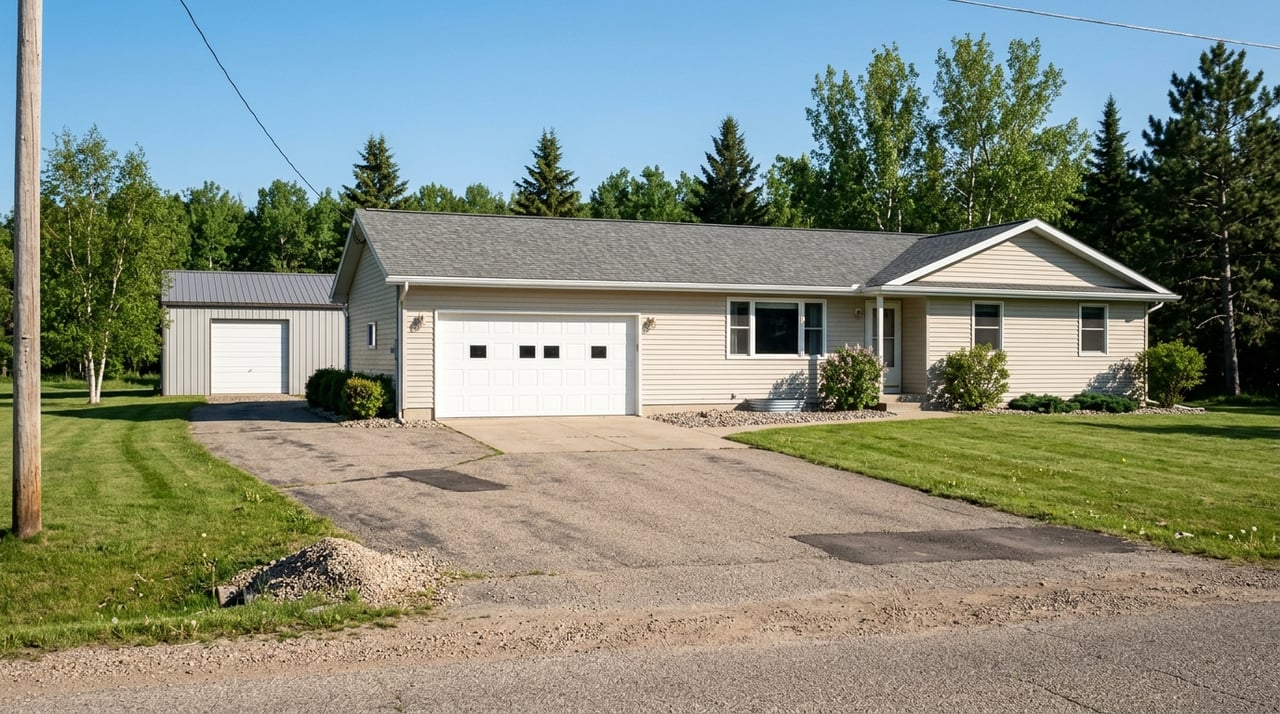
For many buyers in this area, buying an existing home is the more practical choice. A 2025 housing study from the City of International Falls described the city as a buyer's market, with a 2023 median sale price around $147,000, an average home value around $144,486 in mid-2024, and typical days on market around 44.
That kind of market can give you more room to compare options and negotiate than you might expect in a tighter market. If your goal is to move sooner, keep your up-front costs lower, or avoid the uncertainty of raw land and construction scheduling, buying can put you in a home faster and with fewer moving parts.
A big part of the local story is the age of the housing stock. In International Falls, the same city study says only 8.5% of homes were built since 2000. It also reports that 18% of homes were built before 1940, 34.9% between 1940 and 1969, and 38.7% between 1970 and 1999.
Littlefork shows a similar pattern. According to the local profile cited in the research, the median construction year is about 1971, with around 12% of homes built before 1940 and 5.3% built in the 1940s. That means many homes in the area may not be brand new, but they may offer good value if you are open to updates over time.
If you do not love the idea of maintaining an older home, but also do not want the cost and timeline of a custom build, renovation can be the middle path. Buying a structurally sound home in a location that works for you, then improving finishes, systems, or layout over time, can be a smart strategy in this market.
That approach lines up with the local housing supply. Since so many homes were built before 2000, you may find properties that are livable now and still offer room to improve later. For budget-conscious buyers, that can be more realistic than paying for land, sitework, permits, and full construction from scratch.
Building a home near Littlefork or International Falls can absolutely be worth it, but it is important to go in with clear expectations. New construction in this region is not just about choosing a floor plan. It also involves parcel review, permitting, utility coordination, weather planning, and site-specific limits.
If you already own a suitable lot or have a very specific vision for your home, those extra steps may be worth it. If not, they can add time, complexity, and cost that are easy to underestimate.
Before you think about finishes or square footage, you need to confirm whether the land works for what you want to build. Koochiching County notes that its parcel map is provided as a courtesy and is not suitable for legal, engineering, or surveying use. The county also states that the parcel layer was created in 2000 and updates are still in progress.
That means online parcel information is a starting point, not a final answer. If you are creating a new lot or buying acreage, the county's land division process requires details such as parcel ID, acreage, width, legal description, and site plan information. In other words, not every vacant piece of land is automatically ready for a house.
Building also means working through local permits and addressing requirements early. In unincorporated Koochiching County, new structures must obtain an E911 address through the zoning process, and utility service cannot be furnished until that valid address is issued.
Within Littlefork, the city asks residential and commercial applicants to use its land-use permit forms, and city code points residents to Minnesota's small-cities code framework. That does not mean the process is impossible. It does mean you should expect paperwork, review time, and coordination before construction gets very far.
Not all lots are equally buildable. For example, parcels near the Littlefork Municipal/Hanover Airport may be affected by airport zoning and height restrictions. If you are considering vacant land, especially based on appearance alone, this is one more reason to verify what is allowed before you commit.
A parcel can look perfect on paper and still come with limits that affect placement, height, or future plans. That is one of the biggest reasons buyers should look closely at buildability before deciding that new construction is the better route.
Northern Minnesota weather is a real factor in any build timeline. The National Weather Service says International Falls normally gets about 71 inches of snow per season, with an average first frost around September 7 and an average last spring frost around June 7.
That shortens your ideal construction window and can affect everything from excavation to concrete work to final exterior finishes. On top of that, Minnesota rules require minimum frost-protection depths of 60 inches in northern counties, and the Minnesota Department of Labor and Industry notes that permit fees, plan review, and separate trade permits can apply.
Even though local projects vary, national construction data helps explain why building often costs more up front. The National Association of Home Builders reported average construction costs of $392,241, or about $153 per square foot, for a typical single-family home in its 2022 survey. The same survey found construction costs made up 60.8% of the average sales price, while finished lot costs added another 17.8%.
NAHB also reported that the national median price gap between new and existing homes was just $14,600 in early 2025. In a market like Littlefork or International Falls, where resale prices are already relatively moderate, that comparison can push many buyers toward existing homes instead of building new.
There are still clear cases where building makes sense. If you already have a suitable lot, want a very specific floor plan, or care deeply about modern systems and energy performance, new construction can give you more control over the final product.
Building may also fit you if your timeline is flexible and you are comfortable making decisions along the way. In this region, patience matters. Frost depth requirements, permit review, utility planning, and weather all make the process more schedule-sensitive than many buyers expect.
Buying tends to fit you better if you want to move sooner, limit your up-front spending, or avoid the unknowns that come with land and site development. Existing homes also let you see the full property, neighborhood setting, and condition before you make a final decision.
That can be especially helpful in an area where housing values are modest and many homes offer renovation potential. Rather than putting a large share of your budget into lot prep and construction, you may prefer to buy something solid and improve it over time.
Before you choose between building and buying near Littlefork and International Falls, ask these four questions:
If you can answer those questions clearly, your next step usually becomes much easier.
In this market, buying is often the simpler and more budget-friendly route, while building is usually the better fit for buyers with a specific vision and the patience to manage a longer process. Because the area has many older homes and relatively modest resale prices, the hybrid option of buying and updating often deserves serious attention.
That is where local guidance can make a real difference. If you want help comparing vacant land, older homes, or renovation-ready properties near Littlefork and International Falls, reach out to Cari Rostie. With local roots and construction knowledge, she can help you look past the surface and make a decision that fits your goals.
With a commitment to customer service second to none, Cari strives to make her buyers and sellers feel as though they are her only clients. In her real estate experience, she has built a strong base of loyal customers through dedication, ethics, and attention to detail. She is now bringing those same attributes to customers throughout Borderland.